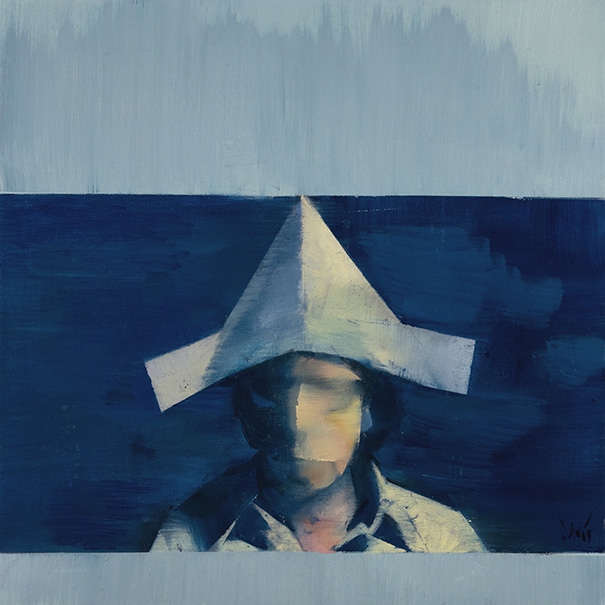
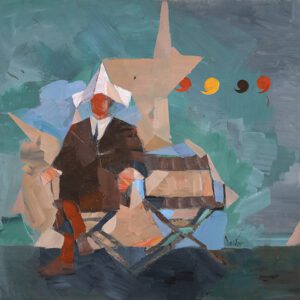
Based on the central portrait in Autoportrait bien fait, mal fait, pas fait (1973) by Robert Filliou, this painting revisits an iconic image within an artistic genealogy in which self-portraiture, exhibition, and institutional structure are closely intertwined. In that work, Filliou portrays himself wearing his Galerie Légitime, a portable gallery conceived inside a hat, shifting the logic of the museum toward a mobile, precarious, and conceptually radical scale.
Rather than simply reproducing a historical image, the painting reactivates the core of that operation: the possibility of turning the body into a site of display and the artistic gesture into a minimal form of institution. In this context, Filliou’s figure is situated within a lineage that connects Marcel Duchamp —Boîte-en-valise—, Robert Filliou —Galerie Légitime—, and Marcel Broodthaers —Musée d’Art Moderne, Département des Aigles—, all of them linked to new forms of circulation, archive, and legitimacy.
Formally, the work is structured around a frontal and restrained image sustained by a deliberately veiled and diffuse pictorial surface. The face and hat-gallery emerge from a compact chromatic field, where layers of oil and dissolved glazes produce a subtle blur that shifts the image into a state of perceptual instability, creating a presence that is at once precise and atmospheric.
The painting belongs to The Paintings Section From Davis Museum Barcelona, where portraiture becomes a means of rereading postwar conceptualism through painting. Executed in oil on canvas and contained within a square format that echoes the museum’s cubic structure, the work belongs to the Full Color Period (since 2019), a phase marked by heightened chromatic intensity, visual density, and emotional concentration.