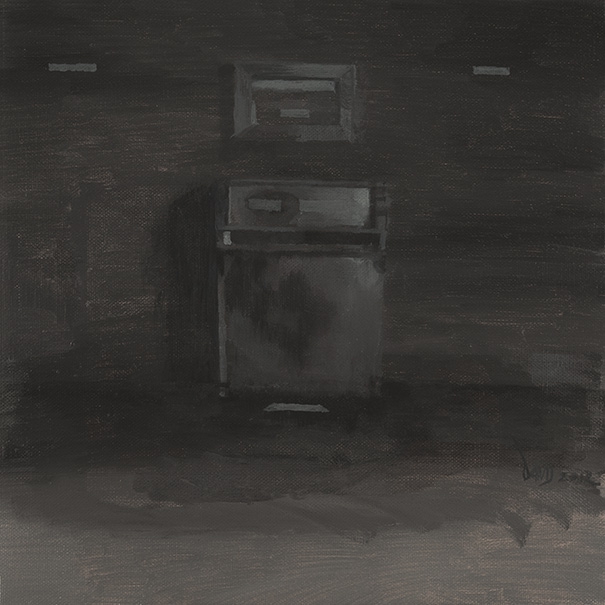
Musée des Aigles Modernes 1
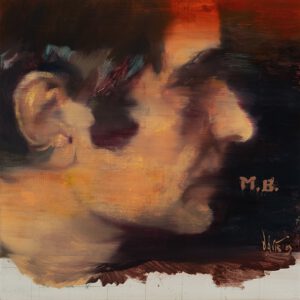
Drawing on a documentary image of a children’s piano in the “Section Cinéma” of Broodthaers’ “Musée d’Art Moderne, Département des Aigles”, the work reactivates the paradigm of the artist-founded museum.
Through blur and painterly mediation, it revisits Richter’s photo-based strategies, suspending the image between documentary record and abstraction.
Within “The Paintings Section from Davis Museum Barcelona”, it extends a genealogy of portable, fictive institutions articulated through contemporary figurative painting.
Original · Signed · Certificate
€700
Product Details
Davis Lisboa, Musée des Aigles Modernes 1, 2012. Oil on linen, 30 × 30 × 3.5 cm (11.81 × 11.81 × 1.38 in).
The painting originates from a black-and-white documentary photograph of a children’s piano installed within the “Section Cinéma” of the Musée d’Art Moderne, Département des Aigles, presented in Düsseldorf between 1971 and 1972. Rather than reproducing the image, the work translates it into painterly terms, shifting it toward an unstable presence in which the reference persists, yet is mediated by the material and temporality of painting.
Formally, it draws on the early photo-paintings of Gerhard Richter, where projected imagery is subjected to a process of dissolution through layered veils of paint. This treatment situates the composition at the threshold of abstraction, holding the motif in suspension while foregrounding the mechanisms of visual mediation.
The work belongs to “The Paintings Section from Davis Museum Barcelona”, a body of work that extends a lineage of artists who conceived the museum as form, from Marcel Duchamp with Boîte-en-valise (1936–1941), Robert Filliou with La galerie légitime (1962–1963), and Marcel Broodthaers with the Musée d’Art Moderne, Département des Aigles (1968–1972). Within this framework, the painting operates both as an autonomous image and as a component within a broader institutional construction.
The Davis Museum Barcelona functions simultaneously as a conceptual artwork and an operative device: conceived within a ballot box—understood as a readymade sculpture—distributed digitally, and structured as both archive and portable museum. Officially recognized by the Generalitat de Catalunya, it establishes a system in which collection, exhibition, and institutional critique converge with precision.
Additional information
| Weight | 2 kg |
|---|---|
| Dimensions | 3 × 30 × 30 cm |