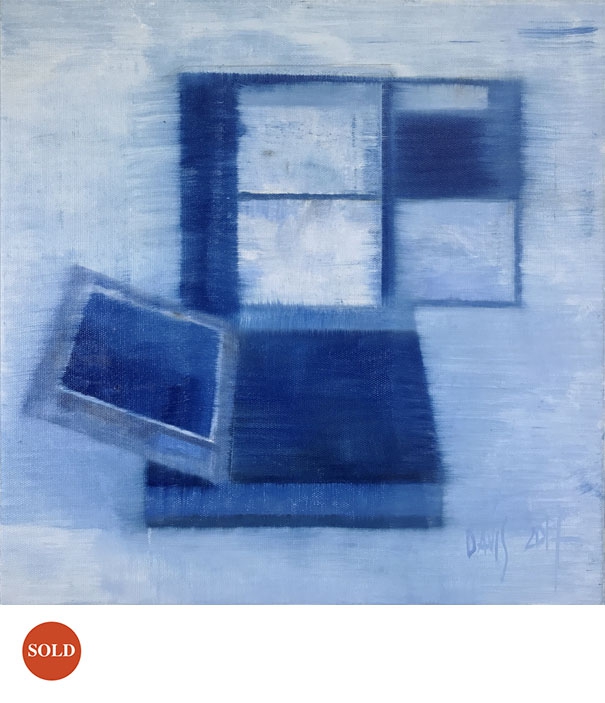
Boîte-en-valise #5
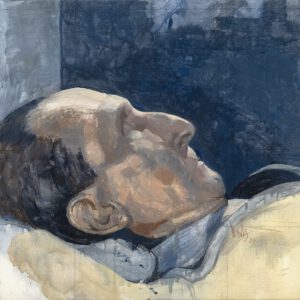
Duchamp’s “Boîte-en-valise” functions as a conceptual space, framing the work as a portable archive in which authorship and self-historicization converge.
The transcription of the photographic image into painterly blur destabilizes recognition, situating the image within a terrain of mediated memory.
Within “The Paintings Section From Davis Museum Barcelona”, the work extends a logic of the artist-founded museum through contemporary figurative painting.
700 $
Product Details
Conceptually, this painting draws inspiration from “Boîte-en-valise” by Marcel Duchamp (1887–1968), one of the most influential yet least widely known works of twentieth-century art. Initiated in 1936 as a “portable museum” assembling paintings, drawings, objects, and readymades in miniature, its first edition was presented in Paris in 1941 under the title “de ou par MARCEL DUCHAMP ou RROSE SÉLAVY”, subsequently giving rise to six partial editions with differing material configurations.
On a formal level, the work enters into dialogue with Gerhard Richter’s photographic paintings developed from the 1960s onward, which are based on the projection, drawing, and subsequent erasure of images drawn from personal and media archives, rendering the depicted subject ultimately unidentifiable.
The painting is situated within a genealogy of artists who founded their own museums—Duchamp, Robert Filliou, and Marcel Broodthaers—through which the Davis Museum, The Davis Lisboa Mini-Museum of Contemporary Art in Barcelona (2009–ongoing), is articulated. Conceived as a readymade sculpture, a non-profit collective art project, and a cultural entity recognized by the Generalitat de Catalunya, it was symbolically created in an electoral ballot box and disseminated primarily via Facebook, and is considered the smallest contemporary art museum in the world.
Within this framework, “The Paintings Section From Davis Museum Barcelona” is divided into portraits and still lifes representing both these artists and their museological projects. The choice of oil on canvas reflects the historical weight of the medium, while only the highest-quality materials are employed. The square format derives from the museum’s cubic structure, and blue is adopted as the identifying color of the entire series. “The Paintings Section” is the only section of the Davis Museum in which artworks are offered for sale.
Additional information
| Weight | 2 kg |
|---|---|
| Dimensions | 3 × 30 × 30 cm |