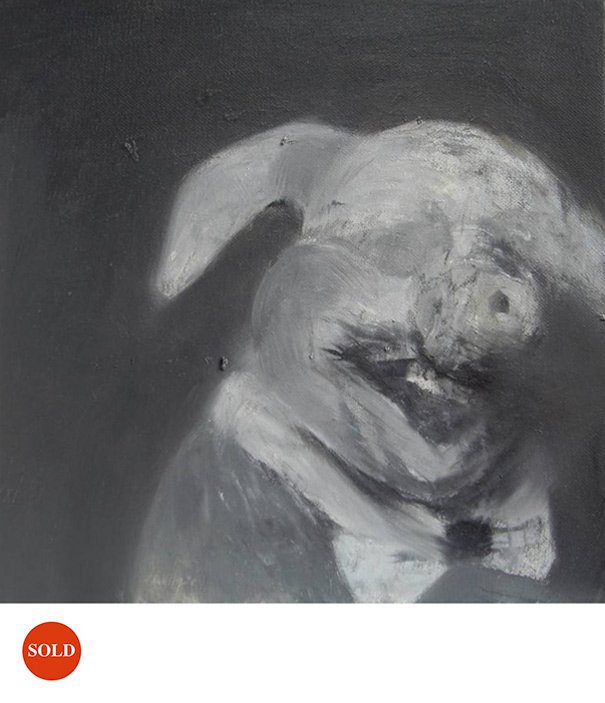
María Cañas Free #1
This unique painting forms part of The Paintings Section from Davis Museum Barcelona, where historical images are reinterpreted through contemporary figurative painting, creating a dialogue between cinema, memory, and institutional critique.
The Brandon Gillian Collection, Oceanside, California, USA.
Original · Signed · Certificate
€610
SOLD
Product Details
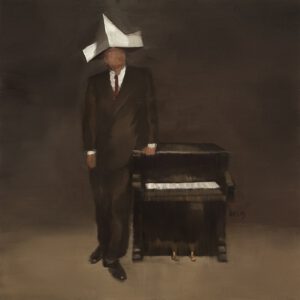
Davis Lisboa, María Cañas Free #1, 2012, oil on linen, 30 × 30 × 3.5 cm (11.8 × 11.8 × 1.38 in).
Conceived within The Paintings Section from Davis Museum Barcelona, this work forms part of a portrait series dedicated to the first artists associated with the museum project. It focuses on the Spanish artist María Cañas, whose practice is rooted in audiovisual appropriation, experimental cinema, and found footage, reusing archival images to construct new readings of contemporary visual culture.
The painting does not portray María Cañas directly. Instead, it is based on a frame from the French silent film Le Cochon Danseur (The Dancing Pig, Pathé Frères, 1907), which the artist herself used as her profile image across her social media platforms. Through this appropriation, the painting becomes a reference to her artistic identity and working method: an indirect portrait constructed from an image that had already been reappropriated by the artist.
The image is reinterpreted through a controlled, translucent application of oil paint. Its blurred surface, inspired by the visual language of Gerhard Richter’s photo-paintings, shifts the viewer’s attention away from physical likeness toward visual memory, the circulation of images, and processes of appropriation.
Created during the Gray Period (2011–2016), the painting adopts a restrained tonal palette that reinforces its quiet intensity. As part of Davis Museum Barcelona, conceived simultaneously as an institutional structure and an artistic proposition, the series extends a tradition of institutional critique initiated by Marcel Duchamp, Robert Filliou, and Marcel Broodthaers. Within this context, the painting reactivates an image born in early cinema, reappropriated by María Cañas, and ultimately transformed into painting.