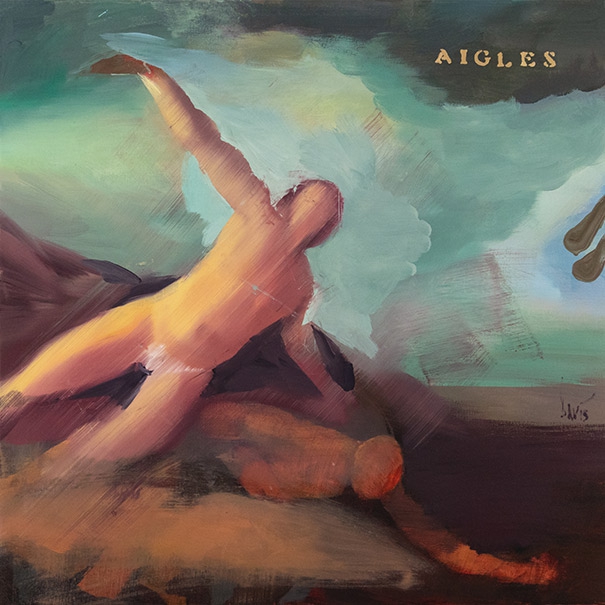
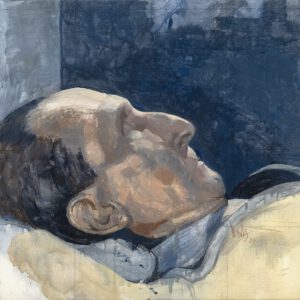
The painting is conceived as an extension of the inquiry initiated by Marcel Broodthaers in Musée d’Art Moderne, Département des Aigles, Section Publicité (1972), where the eagle shifts from a figurative motif to an operative sign. Historically associated with power, sovereignty, and institutional identity, its repeated circulation across images and objects exposes both its symbolic authority and its progressive banalization. Here, its absence does not signal loss but intensification: the sign remains active without requiring representation.
The composition draws on a classical structure, reinterpreted through a restrained painterly language and an open atmospheric field. The reference to Peter Paul Rubens and his Prometheus Bound persists as an underlying presence, where the reclining figure suggests a tension between fall and resistance. Yet the narrative dissolves: the eagle is removed and replaced by the word “Aigles,” suspended within a dark zone that operates as a conceptual focal point. Language assumes a pictorial function, shifting the work from depiction toward a more unstable field of meaning.
The image originates in a study generated through artificial intelligence, later translated into oil on linen. This passage introduces a logic of transformation that runs throughout the work. Rather than stabilizing the initial image, the painting reconfigures it through successive layers, maintaining a visible distance between generation and material realization.
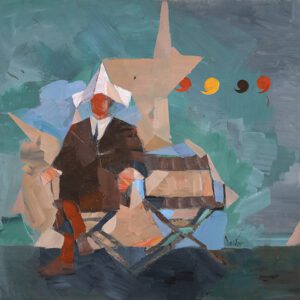
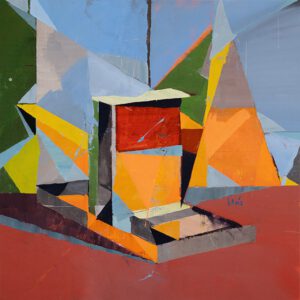
Aligned with practices that have redefined the museum as a critical structure, the work situates itself within a framework where exhibition, archive, and symbolic construction converge. As part of The Paintings Section From Davis Museum Barcelona, it establishes a precise relation between form, system, and circulation. The square format reinforces this internal coherence, while its classification within classical mythology extends an ongoing inquiry into the persistence and transformation of images and signs.